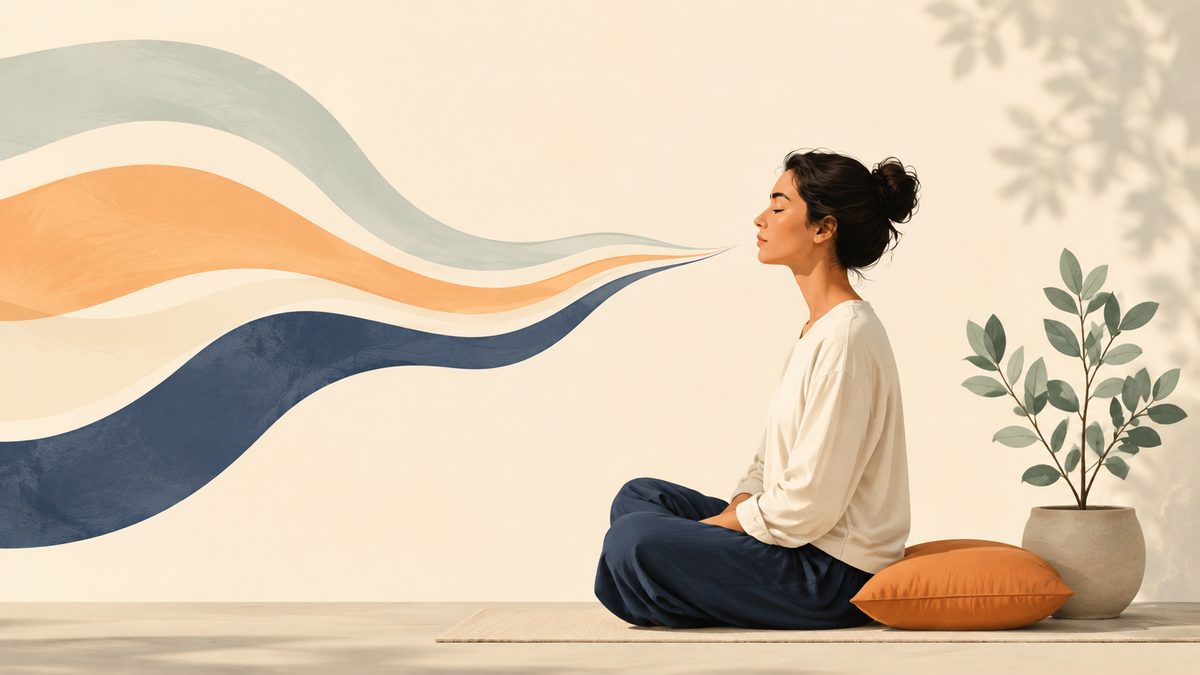
Mindful breathing is the simple habit of bringing your conscious attention to the physical sensation of your breath moving in and out of your
body, without trying to force, control, or judge the experience. You do not need to sit cross-legged on a velvet cushion, chant, or clear your
mind of every thought to do it properly. Taking even three intentional, unhurried breaths while noticing the cool air entering your nose and
warm air leaving your lips is enough to help your nervous system downshift.
If you have ever tried meditating and thought, “I am terrible at this because my mind will not stop racing,” mindful breathing offers a gentler
doorway. You are not trying to stop thinking. You are simply giving your attention an anchor so you can step off the treadmill of anxious
mental chatter for a few minutes.
What Mindful Breathing Really Is (and What It Isn’t)
Most people assume breathing exercises are about taking massive, theatrical gulps of air into their chests. Mindful breathing is different. It
is an act of observation rather than performance.
When you practice mindful breathing, your only assignment is to notice the breath you already have. You feel the rise and fall of your ribs,
the gentle expansion of your belly, and the subtle pause at the top of an inhalation. You treat your breath like an old friend you are sitting
Here is what mindful breathing is not:
It is not a test where having wandering thoughts means you failed. It is not forced hyperventilation or straining to fill your lungs beyond comfort. It is not an escape from reality, but rather a way to arrive fully in the current moment.
When you remove the pressure to achieve a mystical state of Zen, breathing becomes a practical life tool you can use at your desk, in
heavy traffic, or before a difficult conversation.
Why Paying Attention to Your Breath Calms Your Body
Your breath is the only major function of your autonomic nervous system that you can control both unconsciously and consciously. When
your brain perceives a deadline, an argument, or an unexpected bill as danger, your body triggers a fight-or-flight response. Your breathing
turns shallow and rapid, your heart rate climbs, and your muscles tense up.
By consciously slowing and softening your breathing pattern, you send a physical signal back along the vagus nerve to your brain stem.
You are essentially telling your physiology, “We are not running from a predator right now; we are safe.”
This activates your parasympathetic nervous system—the rest-and-digest mode. Your heart rate slows down, blood pressure steadies, and
your digestive and immune systems receive the green light to function normally again. [NEEDS: verify citation on physiological effects of
slow-paced breathing on heart rate variability]. You do not have to persuade your racing mind with intellectual arguments; you calm your
biology first, and your thoughts naturally follow.
The 3-Breath Reset: A Simple Entry Point
Before trying any structured exercise, start with the lowest possible barrier to entry. We call this the 3-Breath Reset. You can do this right
1. Breath One: Take a steady breath in through your nose. Notice the sensation of air flowing past your nostrils. Exhale slowly through your mouth, letting your shoulders drop two inches away from your ears. 2. Breath Two: Inhale gently, feeling your ribs expand outward like an accordion. As you exhale, soften the muscles around your eyes, jaw, and forehead. Unclench your teeth. 3. Breath Three: Inhale quietly into your lower abdomen. As you breathe out, feel the solid weight of your feet against the floor or your hips resting in your chair.
That entire sequence takes under thirty seconds. It does not solve all your problems, but it breaks the unconscious momentum of stress
and reminds your body where you are.
Three Practical Breathing Techniques for Beginners
Once you feel comfortable taking a few conscious breaths, you can explore three time-tested techniques. Pick the one that feels most natural to you today.
1. Box Breathing for Instant Steadying
Box breathing, sometimes called square breathing, uses four equal counts to restore balance and focus. It is widely used by first
responders, athletes, and professionals heading into high-pressure meetings.
Inhale slowly through your nose for a count of 4. Hold your breath gently at the top for a count of 4 (without clamping your throat tight). Exhale smoothly through your mouth for a count of 4. Hold empty at the bottom for a count of 4. Repeat this four-part cycle four times.
The rhythm creates an immediate sense of structural predictability that soothes a scattered mind.
2. The 4-7-8 Rhythm for Evening Unwinding
Developed by integrative health practitioners, the 4-7-8 pattern extends your exhalation. Long exhales act as a natural braking mechanism
for your heart rate, making this technique ideal for winding down before bed or settling sudden spikes of panic.
Close your mouth and inhale quietly through your nose for a count of 4. Hold your breath comfortably for a count of 7. Exhale completely through your mouth with a soft whooshing sound for a count of 8. Repeat for four full cycles.
If counting to seven or eight feels too long at first, feel free to cut the counts in half (2-3.5-4) until your lung capacity adjusts. The proportion
is what matters, not the absolute duration.
3. Natural Breath Observation for Everyday Calm
If counting numbers makes you feel tense or preoccupied with mechanics, skip the numbers entirely.
Simply sit or lie down in a comfortable posture. Close your eyes or soften your gaze downward. Pick one physical spot where you feel your
breath most clearly—the tip of your nose, the center of your chest, or the movement of your belly button. Rest your attention on that single
spot like a lighthouse beam. Let your body breathe itself at whatever pace it wants, simply watching each cycle come and go.
What to Do When Your Mind Wanders (Because It Will)
Here is the most crucial truth about mindful breathing: your mind will wander within twenty seconds. You will suddenly find yourself thinking about what to cook for dinner, an awkward email you sent three years ago, or a noise outside your window.
When this happens, you have not failed. In fact, noticing that your mind has drifted is the exact moment of mindfulness.
Think of it like training a puppy. If a puppy wanders off its blanket, you do not yell at it or throw your hands up in despair. You gently pick it
up and place it back on the blanket. Every time you catch your attention drifting and steer it back to your breathing without self-criticism,
you are building mental resilience.
Three Common Mistakes Beginners Make
To keep your practice sustainable and frustration-free, watch out for these three common traps:
1. Forcing deep chest gasps: Sucking in huge amounts of air using your neck and shoulder muscles actually mimics hyperventilation and can make you feel dizzier or more anxious. Keep your breathing quiet, relaxed, and directed downward into your lower ribs. 2. Expecting instant emotional silence: Mindful breathing is not an off switch for human emotions. It does not erase sadness, fear, or frustration; it simply creates a steady cushion of space around those feelings so they do not overwhelm you. 3. Practicing only during a full crisis: Trying to learn mindful breathing while having an intense panic attack is like trying to learn how to swim in the middle of a storm. Practice for two quiet minutes every morning so the pathway is familiar when you genuinely need it.
How to Build a Daily 2-Minute Habit Without Forcing It
You do not need thirty minutes of open calendar space to make mindful breathing a meaningful part of your life. The secret is “habit
stacking”—attaching two minutes of breathing to a routine you already do every single day without fail.
Try one of these daily triggers:
While your morning kettle boils or your coffee brews. Right after you close your laptop at the end of the workday. When you first sit in your car before turning the key in the ignition. When your head hits the pillow before you turn off the reading lamp.
Commit to just two minutes a day for seven consecutive days. Give yourself permission to be clumsy, imperfect, and human. With each
gentle breath you take, you are teaching your nervous system that peace is never further away than your very next exhale.
Frequently Asked Questions
What is mindful breathing?
Mindful breathing means noticing the natural sensations of breathing and gently returning attention when it wanders.
How long should I practice?
Start with a few comfortable minutes. You can keep it brief or extend it if it feels useful.
What if focusing on my breath feels uncomfortable?
Stop and try another grounding point, such as noticing your feet or sounds around you. Choose what feels comfortable.